Cellgevity – More than and Antioxidant Supplement

the Most health conscious people pay attention to antioxidants and buy antioxidant supplements for one easy reason. they don’t want to feel any older than they have to and choose to enjoy what antioxidants can do for their health . Often though, they might not do everything they want .

What’s the scoop with antioxidants

Antioxidants are the opposite of free radicals. To understand antioxidants , you need to understand how free radicals- rogue electrons- can hurt your health.

Your body is a complex system. It’s a bunch of organs, like your liver and kidneys and your brain , that each does a certain job . Each must perform their role for you to be truly healthy. Your organs are living tissue, composed of countless cells made up of molecules and their component atoms, each with their proper count of electrons. Atoms are tied together into molecules by sharing electrons , but they can become damaged and drop an electron. This produces a free radical and the atom missing an electron will “steal ” it from the closest source , which creates in its turn another unstable atom. What you end up with is a chain reaction that if left on its own , will hurt the cells within the organ tissue and will sooner or later damage the organ.

An antioxidant is a molecule that is able to donate an electron to stabilize a free radical . An antioxidant molecule will not morph into a free radical itself because it will either stay stable with the missing electron or it will be too weak to steal an electron from another atom. The chain reaction is halted . What’s important to understand – to appreciate the scale- is that, according to a well known scientist who studies antioxidants – by the name of Bruce Ames – a cell in your body will be attacked up to 10,000 times in a single day by free radicals. And there are trillions of cells in our bodies.

This onrush by free radicals contributes to (and some will say primarily causes) many of the acute and chronic diseases that we associate with aging. Alzheimers disease, acute and chronic inflammation, coronary disease, cancer, type II diabetes, Parkinsons disease, rheumatoid arthritis and some types of dementia can all be traced back to free radical damage. And thats not the total list.

I believe that it’s actually important to reduce your own production of free radicals, increase your antioxidants and making a decision to purchase antioxidant supplements is one thing you can consider . But it isn’t the whole picture. You should also:

1- Smarten up . It’s difficult to fix the damage when you’re still causing it, so this would be a good time to slow your production of free radicals and there are tons of things you can do to help. You can avoid smoking and smokey rooms , water and air pollution, junk food , substance abuse and even too much exercise.

2- Watch your diet . Eat morefruit and vegetables . Which ones? This list is long but think green foods and think blue foods. Think raw and fresh.

3- Buy antioxidants and antioxidant supplements. Supplements like Vitamins C and E, Resveratrol and Cordyceps are first-class examples of antioxidants supplements that are easy to buy . Do your homework because sources, quality and usability will vary widely, but you can add them as part of your plan.

4- Glutathione is the body’s Master Antioxidant, but not effective as an oral supplement . Oral glutathione supplements apparently won’t survive the digestive system to be absorbed into the bloodstream. Instead you can opt for a Glutathione precursor like Cellgevity. You can also help to support your body’s production of Glutathione by eating more asparagus and broccoli.
Glutathione is Regenerated by Vitamin C

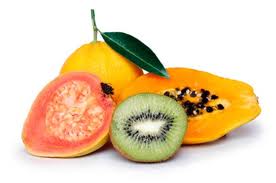
Fruits rich in vitamin CVitamin C is the most important and available water soluable antioxidant within the human body. Actually, vitamin C is almost a generic name for all compounds that exhibit the same biologic activity as AA. The fact that it is water soluable means that it can neutralize free radicals before the reach the cellular membrane. It’s importance was first recognized in 1747 when James Lind found that men could be cured of scurvy when given oranges and lemons. It was a lifesaving discovery.

The relationship between glutathione- the body’s master antioxidant and vitamin C is unique. Vitamin C converts glutathione back to the active form so that it may continue neutralizing free radicals and supporting cellular health. Once reduced, glutathione will regenerate vitamin C from its DHAA or oxidized state. This is one of the reasons that Vitamin C is an ingredient in Cellgevity– the newest glutathione precursor from Max International.

Vitamin C is stored in both the tissues and blood in our bodies. The adrenal and pituitary glands, and lens of the eye contain the highest concentrations of vitamin C within the body. It is one of the 13 essential vitamins although the term “Essential” is often misunderstood. What it actually means is that an essential vitamin is one that must be provided by our diet since we cannot manufacture it within the body.

Vitamin C is important for the production of collagen. It is also important in the formation of norepinephrine and serotonin. Ascorbic Acid may also have some anticlotting and blood flow improvement properties by stimulating the release within the body of Nitric Oxide, which is the most likely reason that Vitamin C is also an important ingredient in the supplement Pro-Argi9-Plus

Five Network AntiOxidants

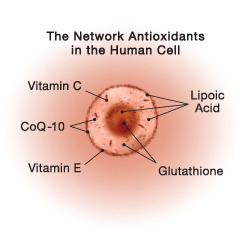
Human cell and network antioxidantsAntioxidants are our body’s most important defense against the damage triggered by free radicals which contribute to many chronic inflammatory and degenerative ailments. Free radicals are the underlying cause of premature aging. Of all the antioxidants, a family of five are acknowledged as Network Antioxidants. This team of both fat and water soluble antioxidants work together to assist your cells and function together to support each other.

When an antioxidant contributes an electron to clean a free radical, it actually becomes one, but a benign free radical without the ability to carry on the chain reaction.  Unfortunately, when they become oxidized, they’re also not able to operate effectively.  But, what is special about the network antioxidants is that are able to help to regenerate each other and carry on the routine of searching out and repairing free radicals.

Even though they function together, the network antioxidants fulfill distinct jobs.  The fat soluble ones, namely Vitamin E and CoQ-10 protect the fatty cell membrane and the cell mitochondria, while the water soluble antioxidants, Glutathione and Vitamin C protect the nucleus of the cell. ALA – Alpha Lipoic Acid is unique in that it is both fat and water soluble.

Vitamin C is the link which connects the fat soluble and water soluble antioxidants in the network and is largely responsible for rejuvenating Vitamin E when it becomes oxidized.

Vitamin E is closely connected with heart attack prevention, because it’s the only antioxidant that can reach fatty portions of the cell that are not accessible to the rest of the network.  It’s basically not a single compound but is instead a family of fat soluble alcohols.

CoQ-10 or CoEnzyme Q-10 is found in all your cells, where it is concentrated in the mitochondria,  the part of your cell that generates energy. Mitochondria are susceptible to free radical injury which has been evidenced as a loss of energy as we age. Additionally, CoQ-10 works in the regeneration of Vitamins E, C and Glutathione

Glutathione, very well regarded as the Body’s Master antioxidant is continuously circulating through your cells, repairing your immune cells and cleaning cellular waste from your body. It supports the rejuvenation of all of the remaining network antioxidants. Increasing your glutathione levels helps protect you from several inflammatory conditions, autoimmune diseases, chronic fatigue syndrome, asthma and others.

Alpha Lipoic Acid is unique amongst the Network Antioxidants in that it is both fat and water soluable and can support both the fatty membrane and water based interior of your cells.  It is also uniquely capable of repairing itself and also can regenerate the other network antioxidants including glutathione. It helps to avoid muscle damage during strenuous workouts.

Like glutathione and CoEnzyme Q-10, ALA is made by your body, but the production capacity falls off significantly as we age.

Alpha Lipoic Acid (ALA) in Cellgevity

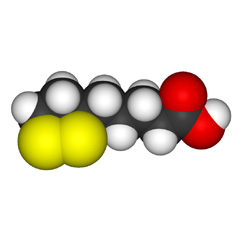
Diagram of ALA MoleculeAvailable in each cell of your body – just  like glutatione – alpha lipoic acid (ALA) is an antioxidant that supports your cells work to convert glucose into energy.  Different from  antioxidants like Vitamin E which can only work in fat or vitamin C which only works in water , ALA functions or more correctly is soluable in both fat and water,  so it works anywhere in your body. Similar to other antioxidants, ALA works to remove free radicals – a.k.a. metabolic waste – from the cells before they are damaged by a build up of waste and toxins.  But, , Alpha lipoic Acid can help to regenerate other antioxidants once they have neutralized free radicals and through the regeneration process render them fit to continue to function as antioxidants again.

ALA is also used as an abbreviation for Alpha Linolenic Acid which is an omega-3 fatty acid, connected with heart health, but this is a different substance from Alpha lipoic acid – also referred to as Lipoic Acid.

Several research studies have indicated that ALA may help to reduce levels of blood sugar and combined with it’s antioxidant properties, ALA could aid  people suffering from diabetic peripheral neuropathy, relieving some of the discomfort and pain created by nerve damage.

Researchers also are looking at  alpha lipoic acid to measure its effectiveness against glaucoma although they are yet to collect enough data, but because it can pass easily to the brain, ALA might be useful as a protector against nerve and brain tissue damage. I’ts being studied as a potential  treatment for stroke and other brain problems with root causes based on free radical damage. Dementia is one such condition.

ALA is an ingredient in Cellgevity where it contributes to the regeneration of the network antioxidants and supports the glutathione network.